

Why Transitions & Context Switching Feel So Hard with ADHD
If you’ve ever felt like moving from one task to the next is harder than the task itself, you’re not alone.
For people with ADHD, transitions and context switching can feel like hitting a wall. Whether it’s:
Leaving “work mode” and shifting into “parent mode”
Closing the laptop and starting dinner
Going from one Zoom meeting straight into another
…the simple act of switching gears drains disproportionate amounts of energy.
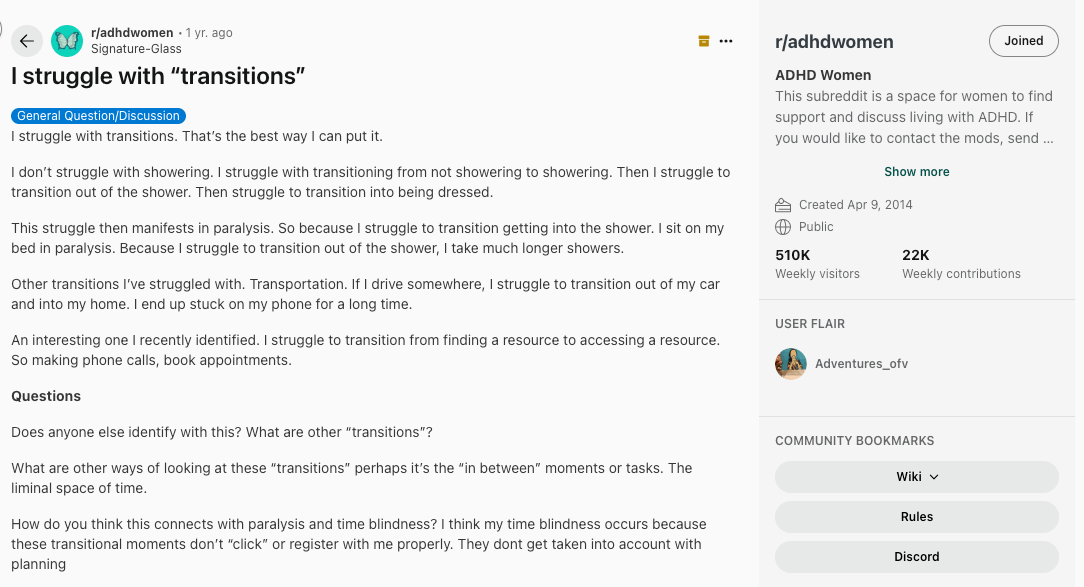
Neuroscience explains this: ADHD brains have differences in executive functioning, dopamine regulation, and time perception. Every transition requires the brain to “reboot” focus and emotional regulation, which costs more mental fuel than it does for neurotypical brains.
Even if you don’t have ADHD, constant context switching is exhausting. That’s why so many working professionals and parents feel fried at the end of the day.
And a leading reason as to why neurodivergent minds = chronic burnout cycles.
The good news? There are ways to make transitions smoother.
Traditional productivity advice pushes rigid routines and strict schedules. But most ADHDers [and most parents, honestly] already know: life rarely runs on rigid rails.
Instead of routine, what our brains and bodies crave is rhythm, flexible patterns that regulate our nervous system and provide scaffolding for change.
That’s where the Transition Pillars come in.
The Transition Pillars for ADHD and Context Switching
When I coach ADHD clients, I guide them through four key areas that I call Transition Pillars. Each pillar is built on the idea of creating your personal dopamenu, small practices that bring energy and regulation to your environment, mind, body, and spirit.
1. Environment Pillar: Grounding Cues
The amygdala [your brain’s alarm system] is extra sensitive during transitions. ADHDers often experience elevated stress hormones like cortisol that make even small shifts feel unsafe. Read more on that here.
Grounding cues calm the nervous system with predictable signals:
Use the same coffee mug when you shift into work focus.
Light a candle when you close work and move into family time.
Dim overhead lights and use a lamp as a “transition signal.”
These cues remind your body: We’ve shifted, but we’re safe here.
2. Mind Pillar: Interoceptive Check-Ins
ADHD brains are fantastic at reading others [exteroception], but often miss internal signals [interoception]. That’s why you realize you’re starving only after a headache hits.
Quick check-ins re-center your mind before a switch:
Am I thirsty?
Do I need to stretch before I dive in?
Is my jaw clenched?
Answering these questions interrupts autopilot and helps you transition resourced instead of depleted.
3. Body Pillar: Rhythm Practices
R
igid routines break when life shifts. Rhythms bend and move with you.
Choose 2–3 practices from your dopamenu that reset your body between tasks:
5 rounds of box breathing
A two-minute stretch
Shaking out your arms and legs
Walking around the block
Your body is the bridge that carries you through transitions. Giving it rhythm makes the crossing smoother.
4. Spirit Pillar: Micro-Boundaries
Every transition comes with pressure, your kids, your boss, your notifications. For ADHDers, this can trigger rejection sensitivity dysphoria (RSD), making it feel terrifying to say no.
That’s why micro-boundaries matter:
“Give me 10 minutes before I start dinner.”
“I’ll answer that message once I finish this task.”
“I can’t talk right now, but I’ll check in later.”
Each small success teaches your nervous system: I can pause, and people still accept me.
Build Your Dopamenu for Common Transitions
The Transition Pillars aren’t about perfection, they’re about having options.
Here’s how to start:
• Ask yourself: What brings energy into my environment, mind, body, and spirit?
• Write down at least 3–5 answers. These are your dopamenu items.
• Choose 2–3 of them to practice during a common daily transition (like work → dinner or meeting → deep focus).
• Rotate them as needed.
Over time, these small practices become natural rhythms that smooth out transitions and protect your energy.
The Bottom Line on Context Switching
Transitions and context switching aren’t character flaws. They’re biologically demanding moments that hit ADHDers, and most parents and professionals, the hardest.
With the Transition Pillars, you give your nervous system the cues, awareness, rhythms, and boundaries it needs. Instead of burning out in the spaces between tasks, you learn to cross those spaces with more ease, presence, and energy.
Just a lass of many facets. TLDR: I’m a resilience adhd coach empowering late diagnosed neurodivergent women from living in states of TENSION to living in a state of INTENTION. As a trauma informed practitioner, I support people through coaching, somatic guidance and communal events.
I may receive a commission for links shared in a blog, podcast, or newsletter. You don’t have to use these links, yet I’d be grateful if you chose to! Thanks again for your support, I hope you find the content supportive, insightful, and helpful!
Recent Posts
See All
Comments

Supporting the neurodiverse in remembering who TF they are through coaching, breathwork & facilitation.


©2025 by adventuresOfV || T&C || Privacy Policy || Home